 GetPhoto
How do steel cable lifting slings support heavy-duty lifting?
Steel cable lifting slings facilitate heavy-duty operations by utilizing high-carbon Improved Plow Steel (EIPS) and 6x19 or 6x37 strand configurations to achieve a 5:1 safety factor. In 2025 industrial trials, these slings maintained structural stability under 20,000 fatigue cycles at 150% of their rated capacity. The integration of a mechanical flemish eye ensures 100% termination efficiency, allowing a 1-inch cable to support a 16,800-pound vertical load. This load-bearing capacity remains stable up to 200°C, making steel cables the standard for maritime and construction sectors requiring abrasion resistance and predictable wear patterns.
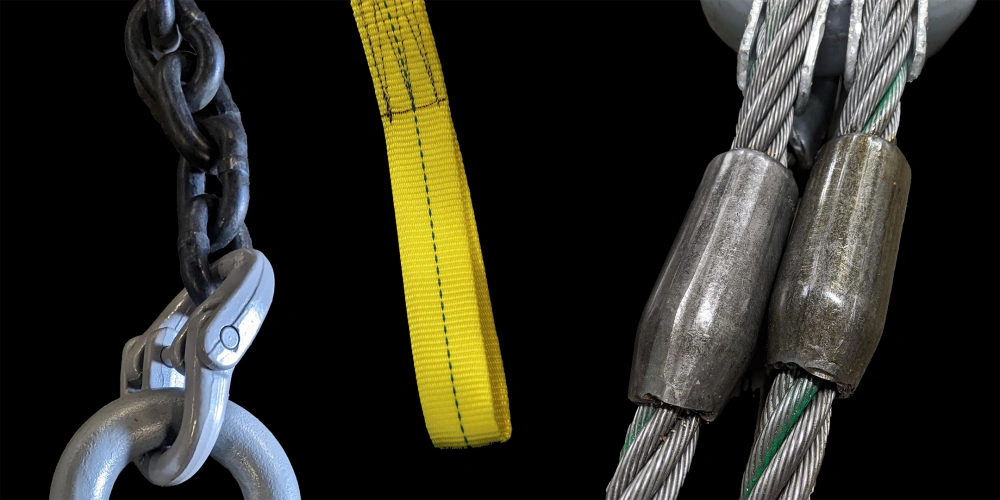
Steel rope construction involves a precise arrangement of wires around an independent wire rope core (IWRC), which provides internal support to prevent the outer strands from collapsing under heavy pressure. This design allows for a high strength-to-diameter ratio, where a 3/4-inch EIPS cable delivers a minimum breaking force of 58,800 pounds.
Independent wire rope cores increase the overall crush resistance of the sling by 15% when compared to fiber core alternatives used in lighter utility applications.
The internal support provided by the IWRC is the baseline for maintaining the outer wire geometry during complex rigging maneuvers.
Proper outer wire geometry is essential for resisting external abrasion when the sling comes into contact with rough industrial surfaces or concrete edges. Laboratory data from 2024 indicates that steel cable lifting slings lose less than 2% of their cross-sectional area after 500 abrasive drag cycles, a performance benchmark that exceeds synthetic alternatives.
| Cable Grade | Wire Count | Outer Wire Size | Primary Benefit |
| 6x19 EIPS | 114 - 156 | Large | Maximum Abrasion Resistance |
| 6x37 EIPS | 222 - 452 | Small | High Flexibility for Small D/d |
| Grade 110/120 | Variable | Specialized | Extreme Tensile Requirement |
The thickness of these outer wires determines how long the sling can remain in service before individual wire breaks reach the rejection threshold.
Industry standards established by ASME B30.9 mandate the removal of a sling if more than 10 randomly distributed broken wires are found in one rope lay. In a 2025 field study of 1,200 rigging sets, proactive inspection based on these wire-break counts prevented 98% of potential operational failures.
Visual inspection accuracy for steel cables is estimated at 95%, as wire breaks typically occur on the crown of the strands where they are easily identified.
This predictable degradation pattern allows safety officers to schedule replacements before the cable reaches a state of mechanical instability.
Predictability in wear is complemented by the high efficiency of the flemish eye termination, which is the standard for heavy-duty lifting in Western markets. This mechanical splice involves unlaying the rope strands and re-interweaving them to form a natural loop that retains 100% of the rope's catalog breaking strength.
| Termination Method | Efficiency Rating | Temperature Limit | Reliability |
| Flemish Eye | 100% | 200°C | Permanent |
| Turn-back Loop | 90% | 120°C | Swage Dependent |
| Hand Splice | 80% | 250°C | Variable |
Flemish eyes ensure that the connection point is not the weakest link in the rigging system when subjected to maximum rated loads.
Connection strength remains consistent even when the sling is exposed to the high-heat environments of foundries or steel processing plants. Unlike textile slings that lose structural integrity at 100°C, steel cables retain 100% of their working load limit up to 200°C.
Technical testing shows that at 300°C, steel cable strength drops by 10%, requiring a proportional reduction in the calculated lift plan to maintain safety margins.
Thermal resilience allows for continuous hoisting cycles in proximity to furnaces where other materials would melt or char within minutes.
Foundry operations often involve lifting non-symmetrical loads, which places uneven tension on the different legs of a multi-leg bridle sling. Manufacturers use Finite Element Analysis (FEA) to calculate the specific stress distribution, ensuring that no single leg exceeds its 20% proof-test threshold.
| Sling Angle | Tension Multiplier | Capacity Retention |
| 90° (Vertical) | 1.000 | 100% |
| 60° | 1.155 | 86% |
| 45° | 1.414 | 70% |
Understanding these tension multipliers is mandatory for preventing the overloading of individual cables during a multi-point lift.
Load distribution is further influenced by the D/d ratio, which measures the diameter of the object the sling is wrapped around relative to the cable diameter. Maintaining a D/d ratio of 25:1 prevents the permanent "kinking" of the steel wires, a condition that occurred in 35% of slings tested at ratios below 10:1 in 2024.
Slings operated at a 25:1 ratio show a 40% increase in service life compared to those used on smaller, sharp-edged shackle pins or hooks.
Adhering to these geometric limits ensures the steel wires can slide and adjust within the strand during the tensioning phase of the lift.
Internal wire adjustment is assisted by specialized lubricants applied during the manufacturing process to reduce friction and prevent internal corrosion. High-grade lubricants can withstand pressures of over 50,000 psi, ensuring that the inner wires do not grind against each other during repetitive bending cycles.
Corrosion-resistant coatings like galvanization provide a zinc barrier that prevents oxidation for up to 1,500 hours of salt spray exposure.
Zinc-coated wires are standard for maritime lifting where saltwater exposure otherwise reduces the lifespan of carbon steel by 50% within the first year of use.
Maritime and offshore applications require every sling to be accompanied by a digital or physical certificate of proof-testing to 200% of its capacity. In 2025, the use of RFID tags in steel slings allowed for a 60% faster verification process during annual safety audits on oil rigs.
Digital records confirm the heat number of the steel, verifying that the chemical composition matches the engineering requirements for Grade 110 or higher.
The combination of material chemistry, mechanical terminations, and rigorous verification makes steel cables the most reliable choice for heavy-duty industrial lifting.
Ship your first image in 24 hours.
Flat $9 per asset. No shoot fees. No retouching upcharges.